
Sinus CT vs. Standard X-Ray: Why Might an ENT Recommend CT Imaging?
If you have been dealing with recurring sinus pressure, congestion, or infections, you may eventually hear your ENT mention imaging. That can raise a simple question: Why a CT scan? Wouldn’t a standard X-ray show what is going on?
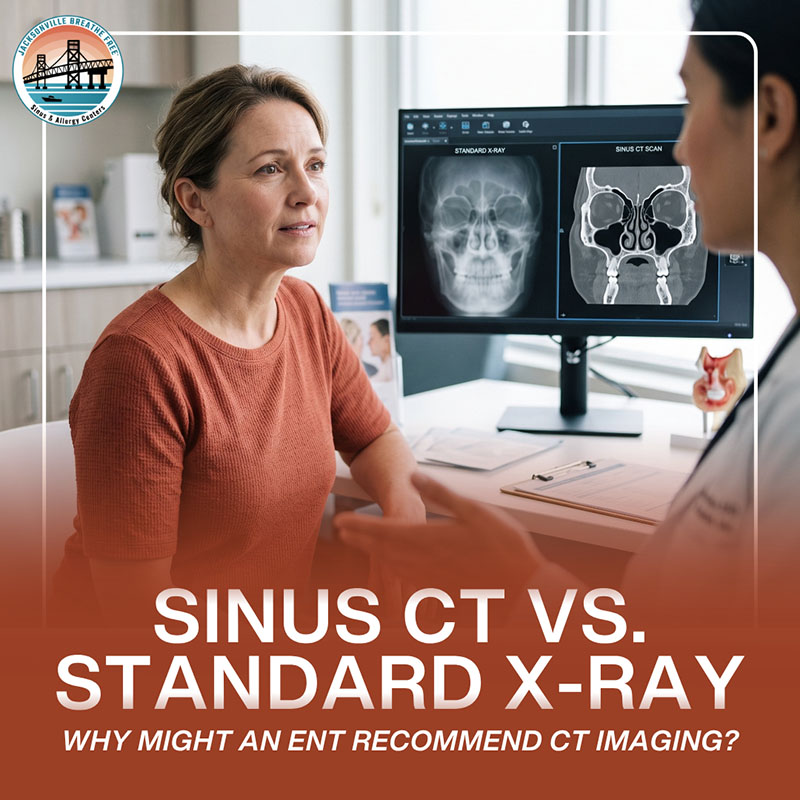
Both tests use X-rays to create images of the body, but they do not provide the same level of information. A conventional sinus X-ray produces a relatively limited view, while a CT scan creates detailed cross-sectional images of the nasal and sinus structures.
However, not everyone with sinus symptoms needs imaging. For uncomplicated acute sinusitis, imaging is generally not recommended.
At Jacksonville Breathe Free Sinus & Allergy Centers, an ENT may recommend CT imaging when a more detailed evaluation of the sinuses is clinically appropriate to help clarify persistent symptoms, investigate suspected sinus disease, or plan treatment.
What Is the Difference Between a Sinus X-Ray and CT Scan?
A standard X-ray produces a two-dimensional image. Structures in the nose and sinuses are projected onto the same image, which can make it difficult to distinguish certain areas from one another.
A CT scan uses X-ray technology and computer processing to create detailed cross-sectional images. These images can be examined individually or reconstructed into different views of the nasal and sinus anatomy.
The difference matters because the sinuses contain several small spaces, openings, and bony structures that can be difficult to assess clearly on a conventional X-ray.
CT imaging generally provides a more detailed view of these structures when a healthcare provider needs to investigate a specific sinus-related concern.
What Can a Standard Sinus X-Ray Show?
A conventional sinus X-ray may provide a general view of certain sinus spaces and reveal obvious abnormalities, such as significant fluid accumulation or changes in the appearance of a sinus.
However, standard sinus X-rays have important limitations.
Because multiple structures overlap on a two-dimensional image, smaller drainage pathways, subtle anatomical changes, and certain patterns of sinus disease may be difficult to evaluate.
Conventional sinus X-rays also have limited diagnostic accuracy and are generally not recommended for routine evaluation of suspected sinusitis.
Many patients with uncomplicated sinus symptoms do not need imaging at all.
When imaging is clinically indicated, CT usually provides more useful anatomical information than a conventional sinus X-ray.
What Does a Sinus CT Show That an X-Ray May Not?
A CT scan provides substantially more detail about the anatomy of the nose and sinuses.
It may help an ENT specialist evaluate:
- The individual sinus cavities
- The openings through which the sinuses drain
- Thickening of the sinus lining
- Fluid or retained secretions
- Soft-tissue findings that may be consistent with nasal polyps or inflammation
- A deviated septum
- Narrow areas within the nasal passages
- The surrounding sinus bones
- Anatomical variations that may affect sinus drainage in some patients
Because CT images can be viewed in multiple planes, an ENT can assess these structures from different angles rather than relying on a single projected image.
However, CT cannot always distinguish nasal polyps from inflamed tissue, mucus, or other soft-tissue abnormalities.
Similarly, an anatomical variation or narrowed drainage pathway visible on CT does not automatically mean it is causing symptoms or requires treatment.
An ENT may use nasal endoscopy, clinical history, examination findings, and other information to clarify the diagnosis.
If you are considering an ENT evaluation, you can also review these factors to compare when selecting an ENT in Jacksonville.
Why Does Detailed Anatomy Matter?
Sinus symptoms are not always caused by the same problem.
Two people may both experience facial pressure and congestion, but the underlying causes may be different.
One person may have chronic sinus inflammation, while another may have an anatomical narrowing that affects a sinus drainage pathway. Someone else may have nasal polyps, allergies, or a combination of contributing conditions.
A detailed CT scan can help identify structural or inflammatory findings that may not be apparent during a routine examination or conventional X-ray.
However, not every finding on CT is clinically significant.
For example, a narrowed drainage pathway or mild mucosal thickening may be present without causing meaningful symptoms.
CT findings must therefore be considered alongside the patient’s symptoms and other examination results.
Detailed anatomical information can also be useful when an ENT is considering a sinus procedure. Understanding the location of sinus openings, surrounding structures, and anatomical variations may help guide treatment planning.
Does a CT Scan Always Mean You Have Chronic Sinusitis?
No.
A CT scan does not automatically establish a diagnosis of chronic sinusitis.
Chronic rhinosinusitis is generally diagnosed based on a combination of persistent symptoms and objective evidence of sinonasal inflammation, which may be identified through nasal endoscopy or CT imaging.
CT scans can show changes within the sinuses, but not every abnormal finding means chronic sinusitis is responsible for a person’s symptoms.
For example, temporary inflammation may occur during a cold or another respiratory infection.
Some people also have mild sinus abnormalities on imaging without experiencing significant symptoms.
That is why an ENT considers the duration, pattern, and nature of symptoms alongside imaging and examination findings.
A CT scan can contribute important diagnostic information, but it should not be interpreted in isolation.
Why Might an ENT Choose CT Over an X-Ray?
An ENT may recommend CT imaging when detailed anatomical information is likely to help answer a specific clinical question.
Situations in which CT may be considered include:
- Persistent sinus symptoms when chronic sinus disease is suspected
- Recurrent episodes of suspected sinusitis that warrant further evaluation
- Symptoms or examination findings that require additional anatomical assessment
- Suspected structural abnormalities affecting the nasal or sinus passages
- Nasal polyps or other abnormalities that require further evaluation
- Planning for certain sinus procedures
- Selected situations involving suspected complications or other concerning findings
In these circumstances, CT can provide information that conventional sinus X-rays may not reliably capture.
However, CT imaging is not routinely necessary for uncomplicated acute sinusitis or every episode of nasal congestion or facial pressure.
Your ENT will consider whether imaging is likely to change the diagnosis, evaluation, or treatment plan before recommending it.
Is a Sinus CT Safe?
CT scans use ionizing radiation, so they are generally recommended only when the expected diagnostic benefits justify the exposure.
The amount of radiation varies depending on the scanning equipment, imaging protocol, and other technical factors.
When clinically appropriate, a low-dose sinus CT protocol may be used to reduce radiation exposure while obtaining the images needed for evaluation.
Your healthcare provider can consider your symptoms, medical history, previous imaging, and whether another examination or imaging approach could answer the clinical question.
A routine sinus CT is generally performed without intravenous contrast, although contrast-enhanced imaging may be needed in selected circumstances.
The scan itself is usually quick and painless.
If you are pregnant or may be pregnant, inform your healthcare team before undergoing imaging so the examination can be assessed appropriately.
What Happens After a Sinus CT?
Your ENT will review the imaging findings alongside your symptoms, medical history, and physical examination.
The results may help clarify whether sinus inflammation, narrowed drainage pathways, soft-tissue abnormalities, a deviated septum, or another anatomical condition could be contributing to your symptoms.
However, a CT scan does not always establish which finding is responsible for a patient’s discomfort.
If the scan does not show significant sinus disease, that information can also be useful.
For example, facial pressure or headaches may sometimes have causes unrelated to sinus inflammation, and further evaluation may be appropriate.
Depending on the findings, your ENT may discuss continued medical management, additional testing, observation, or a procedure when clinically indicated.
The goal is not simply to obtain a more detailed image. It is to use the information to guide an individualized clinical decision.
Which Is Better: Sinus CT or X-Ray?
For most patients with uncomplicated sinus symptoms, neither test is routinely necessary.
When an ENT needs detailed imaging to evaluate suspected chronic or recurrent sinus disease, investigate selected concerning findings, or plan a sinus procedure, CT is generally preferred over conventional sinus X-rays.
CT provides a more comprehensive view of the sinus cavities, drainage pathways, and surrounding anatomy.
Conventional sinus X-rays have limited diagnostic accuracy and generally do not provide the level of detail needed for these purposes.
However, the decision to obtain imaging depends on the patient’s symptoms, medical history, examination findings, and the specific clinical question being investigated.
Your ENT can help determine whether a CT scan is appropriate or whether another evaluation approach would be more useful.
Still Dealing With Sinus Symptoms That Won’t Go Away?
Recurring congestion, facial pressure, drainage, or suspected sinus infections can be difficult to manage when the underlying cause remains unclear.
If symptoms persist despite appropriate care, an ENT evaluation may help identify possible contributing factors and determine whether additional testing is necessary.
For some patients, CT imaging may provide useful anatomical information. For others, a clinical examination or different diagnostic approach may be more appropriate.
Book an appointment with Jacksonville Breathe Free Sinus & Allergy Centers to discuss your symptoms and find out whether CT imaging or another evaluation approach may help guide your care.

